|
|
|
| Malaya Garnet |
|
|
|
|
|
 |
|
|
|
|
|
|
|
The Story |
|
|
 A day of July 1996 whereas I stopped in a small village in Madagascar; one presented samples of a strange stone to me. At first sight its color could reminds certain zircon, but I quickly identified it as garnet. After some palaver, one led me to the place of the discovery. I must acknowledge that I already knew the inhabitants with whom we tied friendship the previous year. On the spot, a notch of about one meter fifty in a white color rock had created a not very impressive hole. But, according to its authors, it was particularly painful to produce it with iron bars only. I readily believed them after to be approached to the rock. Some particles of this stone to the orange - pink-brown reflections remained taken in the bedrock. I encouraged my friends to be still sought. A day of July 1996 whereas I stopped in a small village in Madagascar; one presented samples of a strange stone to me. At first sight its color could reminds certain zircon, but I quickly identified it as garnet. After some palaver, one led me to the place of the discovery. I must acknowledge that I already knew the inhabitants with whom we tied friendship the previous year. On the spot, a notch of about one meter fifty in a white color rock had created a not very impressive hole. But, according to its authors, it was particularly painful to produce it with iron bars only. I readily believed them after to be approached to the rock. Some particles of this stone to the orange - pink-brown reflections remained taken in the bedrock. I encouraged my friends to be still sought. |
|
|
|
 |
|
|
|
|
|
|
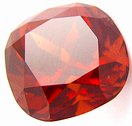
The first samples extracted from a not disaggregated leptynite did not exceed 3.15 cts. after |
|
cutting. |
|
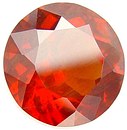
The observation under day light and incandescent light showed a clear difference in color. |
|
Its change, from the champagne color under daylight, to an intense red for some, or to |
|
pink-orange for others is due to chromium and vanadium traces. |
|
This characteristic confers an attractive aspect on these gems. |
| |
|
|
Other samples were orange-yellow and did not change color under the various sources of lighting. |
|
Unfortunately, the very hard and compact rock in this place, did not allow to extract many stones |
|
from it, and the occurrence was abandoned a few weeks after its discovery. |
|
|
|
|
|
|
|
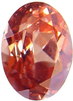
Opposite, first samples cut in 1996 showing a change of color. |
|
 |
|
|
|
|
|
 |
|
|
|
|
|
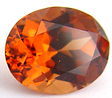
Above, an orange malaya found also in the |
|
|
primary occurrence. (It does not change color) |
|
|
|
 |
This is two years later, in September 1998 exactly, that returning in the small village, the |
|
samples more or less similar to those which I made cut in 1996 were found. They were turbid because of the fine rain of small inclusions they contained. Their color was definitely more orange than malaya garnets from the first occurrence. Indeed, they did not come from the same place. This is a little more than one kilometer of distance that the elluvionnar deposit was discovered. |
|
I was immediately conscious to be the witness of a rare moment in the career of an impassioned |
|
person for precious stones. |
|
At this time orange garnet fever was launched. |
|
The stone did not show almost any more change, its champagne-orange color at the day |
|
was simply reinforced in a vivid orange or for other elements in an orange-red under electric light. |
|
This type of garnet is a pyrope-spessartite also containing vanadium and chromium traces. |
|
On the totality of Malaya extracted, a small part was pure, but much showed typical inclusions of |
|
this stone. |
|
|
|
Initially networks of rutile needles and strain patterns were often present, and inclusions of |
|
graphite accompanied them. |
|
Negative crystals and, quartz, apatite, monazite and zircon had been also invited during the |
|
growth of the precious malaya garnet. |
|
|
 |
|
 |
|
|
| |
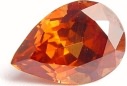
Here, the first pyrope- |
|
spessartite cut in 1998. |
|
|
|
|
exceptional by the quality of its product and also by the fact that it was the second deposit in |
|
the world to deliver this type of Malaya garnet. |
|
|
|
|
|
|
|
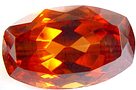
| Here, one of the single intact garnets |
| found in the occurrence. |
| Its unusual stacking shape must be noticed. |
|
|
|
|
|
|
|
Refractive Index: |
1.73 - 1.81 |
|
Chemical Composition: |
[Mg3 + Mn3]AL2(SIO4) |
|
Hardness: |
7 - 7.5 |
|
Density: |
3.65 - 4.20 |
|
Crystal Group: |
Cubic |
|
|
|
|
|
|
|
|
 |
| Almandine |
Fe3Al2(SiO4)3 |
| Pyrope |
Mg3Al2(SiO4)3 |
| Spessartite |
Mn3Al2(SiO4)3 |
|
|
|
|
|
|
|
|
| |
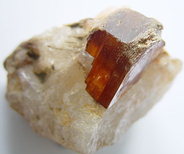
Above, the single phlogopite mica found in the neighborhood of the deposit at that time, it is still |
|
in its gangue. Of transparent quality, it shows a similar color to that of malaya garnets. |
| |
|
|
|
" Personal Collection A. Darbellay " |
|
|
|
|
|
|
 |
|
|
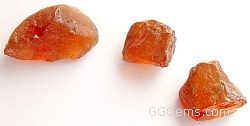
| Here, typical rough material found at that time. |
| Its original shape has been altered. |
|
|
|
|
|
|
| Geology, Introduction : |
|
| Crystal schists. |
|
| The most striking character of the group in this region is the extreme abundance of graphite |
| which occurs mainly in leptynites , but also in a wide variety of rocks and then as accessory |
| element. |
| The group also comprises biotite gneiss, amphibolite gneiss, feldspathic amphibole or not, |
| quartzites, metamorphic marbles, some micaschists. Plagioclase are playing a very subordinate role. |
| The frequency of the garnet is great. Most characteristicals minerals are graphite, amphibole, |
| orthoclase ( leptynites ), biotite, and garnet. |
| Old granites are extremely rare and transformed into orthogneiss. |
| In its most part, the group is mainly of paragneiss origin. We must except leucocratic |
| ortholeptynites that easily separate from abundant paraleptynites rich in garnet. |
| Graphitic leptynites are fully leucocratic rocks without aluminous minerals, at kaolinized feldspars. |
| Their mode of occurrence, as regular intercalation in the schistosity, seems to indicate a |
| sedimentary origin, but similar leptynites often eyed and loaded of graphite, overlap significantly |
| stratification in some place. In this case it derived markedly of leucocratic granites and pegmatites. |
| The mineralization comprises graphite, garnet, manganese, and gold. |
|
|
|
 |
|
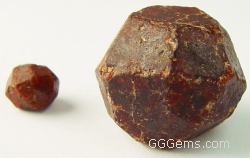
| The only malaya garnets found intact, in their original |
| shape, at the time of the discovery in 1998. |
|
|
| " Personal Collection A. Darbellay " |
|
|
|
|
|
|
|
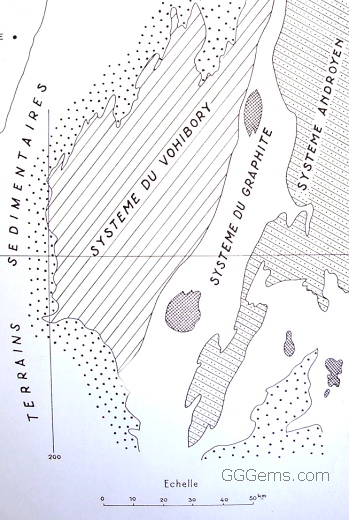
| Anorthosito-noritic clumps. |
 |
|
| All these clumps are roughly subinterstratified |
| in crystalline schists, but show recuting |
| fingerings and contain intact enclaves, |
| sometimes important, in crystalline schists. |
| Then, in detail, there are between gabbroic |
| clumps and host rocks crystalline schists, local |
| discrepancies that seem to imply posterity |
| gabbros compared with schists. These |
| phenomena are esecially distinct in the |
| South-eastern part of the clump near the |
| village of Fenoanevo, where a series of intact |
| enclaves, although surrounded by a border of |
| anorthosic gneiss and leuco noritic, appears in |
| stratigraphic continuity with the neighboring |
| base. It is the same thing in the other clumps |
| of the region. ""The presence of such enclaves |
| is likely to mean for anorthosite and rocks that |
| accompany an "in situ" formation in the solid |
| state. These clumps appear in the Basic series |
| of Graphite-Manganese System. They appear |
| on both sides of the Graphite beam, they |
| underline the limits, both western and eastern, |
| with the external systems, Vohiborian in the |
| West and Androyen in the East. |
|
|
|
|
|
| Enclaves of crystalline schists. Small enclaves of crystalline schists were identified within the |
| gabbroic mass. These enclaves, which dimensions are of the order of several hundreds of meters |
| long and tens of meters wide, seem to have retained without any alteration their orientation and |
| initial petrographic composition. This is leptynites, leptynitic gneiss, sillimanite gneiss and |
| micaschists. Important point to note, the hyperaluminous character of these formations is in |
| harmony with the rich in alumina-anorthosito hyperitic complex. |
|
|
|
| Géological References: A. Lacroix, J.Giraud, M. Raoult, H.Bessairies. |
|
|
| © 1987 - 2025 GGGems.com, All Rights Reserved. |
|