|
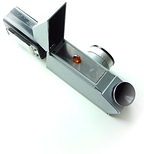
 The Polariscope, here a pocket polariscope. The Polariscope, here a pocket polariscope. |
|
| It is the usual means by which one differentiates on the one hand |
| the unirefractives substances (amorphous or coming from the cubic |
| system) and the birefractives substances, coming from the other |
| systems of crystallization. |
| This instrument is composed of two filters polarizing between which |
| the stone is placed, and it is while turning the filter of the top that |
| the analysis can be done. |
|
 |
|
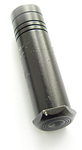
| The refractometer is used to determine the indexes of refraction |
| of the stone. This instrument calculates speed with which luminous |
| rays arise from the stone and indicates it on a scale. The gem is |
| placed on a coated pane of a fine particle of liquid made up amongst |
| other things of methylene iodide which shows an index of refraction |
| of 1.81 (this liquid is toxic) |
|
|
 |
|
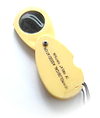
| Dichroscope of which the principal part is made up of a tube |
| comprising a window with the one of the ends and a lens with the |
| other, between the two is assembled a piece of calcite, chosen |
| because of its strong double refraction so that two images of the |
| window appear side by side to the observer which looks in the |
| eye-glass. The light of the adjacent images of the window vibrates |
| in two perpendicular plans one to the other at a rate of one only plan |
| for each image. The rotation of the stone is a significant factor |
| during the control of dichroism, bus in all the double refraction |
| stones, it exists one or two directions of unirefringence, known as |
| optical axe. |
 |
|
|
| The Chelsea color filter. There is a very effective means to |
| reveal the subjacent differences in color, it is the use of colored |
| filters. |
| They are especially effective in the differentiation of natural and |
| synthetic emerald. |
|
|
 |
|
|
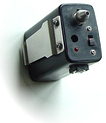
| The optical fiber lamp is useful to distinguish inclusions in rough |
| stones. |
|
|
|
|
 |
|
|
|
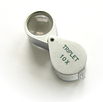
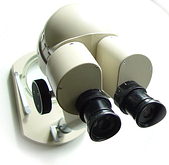
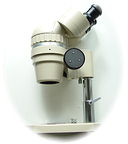
| Microscopes: the binocular one, i.e. to double objective is best |
| adapted for gemology. The microscope is of first importance in |
| the detection of counterfeits. Indeed, the study of inclusions |
| which the stone can contain is a practical means to identify the |
| gems while explaining to a certain extent the conditions under which |
| they were formed in nature. |
|
|
 |
|
|
|
 |
 |
| Malaya garnet discovery |
|
|
|
|
| The spectroscope concerns an extremely simple method which |
| allow the identification of all the stones; rough or polished not being |
| able to be seen with the refractometer and which even makes it |
| possible to distinguish certain synthetic or glasses. This method |
| makes it possible to analyze the nature of the dye of the stone. The |
| way in which the spectroscope analyzes the various wavelengths of |
| the light is in theory very simple; that depends on the different |
| degree of refraction to which its subjected various rays of each color |
| (wavelength) when they are propagated through a prism of glass or |
| another transparent substance. After having passed through a |
| prism, a narrow parallel beam of white light is spread out in a ribbon |
| with the colors of the rainbow, the visible spectrum. |
|
| Let us note that a powerful instrument used in many fields of science |
 |
is at disposal of the gemologists, it is the microscope of Raman which |
| spectroscopy supplements the traditional technology of the |
| laboratory. This instrument can give information on samples lower |
| than 1µm what is not accessible to any technique. The use of the |
| Raman spectroscopy by imagery is unique in order to determine in a |
| nondestructive way the molecular composition of inclusions present |
|
in the gems. |
|
|









 Beauty; it depends on the following characters: