|
|
|
|
|
|
 |
|
| A study of MADAGASCAR TOURMALINE |
|
|
| (Na, Li,Ca) (Fe2, Mg, Mn, Al)3 Al6 I(OH)4 I (BO3)3ISi6O18I |
 |
|
| · Tourmaline crystallographic properties: Trigonal. |
|
| Hardness 7 - 7.5 |
| Density 3.02 to 3.26 |
| Refractive index: 1.62 - 1.64 |
|
| · Chemical Properties: Alumina borosilicate with fluorine. |
|
| Occurrences: In the acid magmatic rocks and associated |
| pegmatites, limestones and schists, placers. |
|
|
|
| Coloured tourmalines are related to sodolithic pegmatites. |
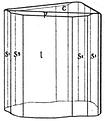
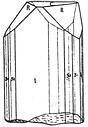
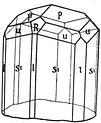
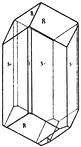
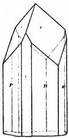
| One distinguishes two principal types of tourmalines: the hexagonal type and the triangular one. |
| · The hexagonal type is especially characterized by the presence, in the prismatic zone, of |
| the well developed S1 faces, and those of L always narrow. When the crystals Bi-terminated, |
|
| one finds with the one of the ends of the ternary axis the rhomboedron R, and with the other |
|
| same the rhomboedron combined with that (0111) = P. |
|
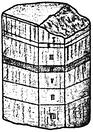
| · The triangular type, here is never finished at the two ends, it is characterized by the |
|
| prevalence of faces I in the prismatic zone, while those S are very narrow just as those S2 |
|
| which accompany them. The crystals on the finished end carry the base C, combined with |
|
| the rhomboedron R; in the same way sometimes with the rhomboedron P and the base C |
|
|
|
|
|
 1 1 |
 2 2 |
 3 3 |
 4 4 |
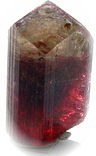 |
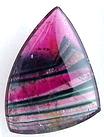
| Fig. 1& 2 : Triangular type |
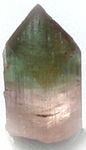
Fig. 3 & 4 :Hexagonal type |
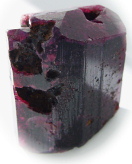
Very rare type of |
|
|
Rubellite from Antsongombato |
tourmaline: white head |
|
|
|
|
and red body. |
|
|
|
|
|
|
|
|
|
|
|
|
|
|
|
 5 5 |
 |
 6 6 |
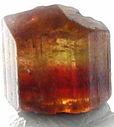 |
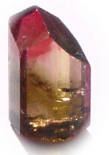
| Crystal of the hexagonal type finished |
Polychrome tourmaline being in Tsilaizina, Madagascar. |
| at a peak frequently found in Tsilaisina. |
|
| |
|
|
|
|
 |
 |
 |
 |
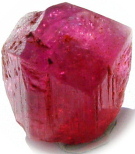
| Liddicoatite Tourmaline |
Deep-PinkTourmaline |
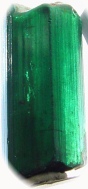
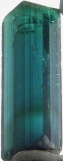
Blue-greenTourmaline. |
Indigolite |
| from Anjanabonoina. |
Antsongombato type. |
( Kunar valley, Afghanistan.) |
|
|
|
|
|
| · Colors of tourmalines: Blue is due to bivalent iron, (magnesium gives a clearer blue) the manganese produce tone |
| from pink to red, chromium and vanadium is in green tourmalines, the yellow and the brown one is produced by |
| trivalent iron. |
| |
 |
|
 |
 |
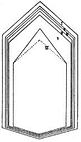
| Diagrammatic provision of a complete crystal cut parallel to the ternary axis. |
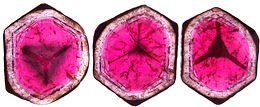
Growth zoning and geometrical drawings in a tourmaline sliced in section from Vohitrakanga. |
SLICED TOURMALINE |
| |
|
|
| |
|
|
|
|
|
|
 |
|
|
|
 |
 |
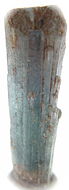 |
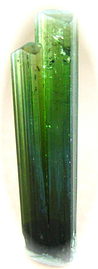
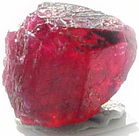
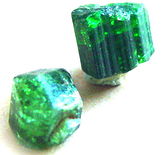
| Rubellite |
Chrome Tourmalines |
Indigolite from Anjamiary. |
Macle of green tourmaline |
| Antsongombato type. |
from Tsaniria. |
( Madagascar ) |
Estaknala ( Pakistan ) |
| ( Madagascar ) |
( Madagascar ) |
|
|
|
| Rubellite from Antsongombato: |
|
The crystals of this remarkable mineral are very variable in size, small one are homogeneous only and of a beautiful pigeon blood red color lighter or darker. Those larger almost always have a complex structure and are formed by concentric zones. At the time of the deposit discovery, very large crystals were quite exceptional and were still inhomogeneous.
In some rubellites, alternating zones are all colored in red, more or less vivid, the center is such an intense purplish red, middle and peripheral zones are red or pink in various shades and even colorless. In other stones the center is composed of yellow or brown, and the periphery composed by rubellite. The reverse also occurs on large crystals that appear black while the central parts show of a beautiful red. When color zoning are numerous they are very thin. The optical properties of tourmaline from Antsomgombato examined on blood-red pieces, lighter red and zoned crystals show that they are all slightly biaxial.
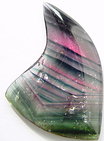
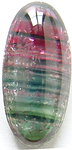
In Tsilaisina, zoned crystals are also very common. Some crystals show some zones of alternating color and which are not concentric, but arranged in parallel layers over the height of the prism. Here pink tourmaline is distinguished from others by its low content of manganese and a high proportion of lime.
The main fact that emerges from the observation of tourmalines from the above occurrences, is their undeniable relationship. All tourmalines contain manganese in varying proportions, and sometimes substantial, all are of a remarkable poverty in magnesia and iron oxide with the exception of black tourmaline. The silica and alumina will undergo changes that reach only 2%, and the total amount of alkali is between 1.04 and 3.48%. Fluoride, always constant, oscillating between 1.4 and 0.73% boric acid and between 9.46 and 11.03%. The most alcaliferous tourmaline is the red of Antsongombato, 3.48%. The alkalies do not seem to have a direct influence on the coloration. Here, manganese is probably the main chromogenous factor, but the color also depends on the elements that accompany it. The combined presence of lime appears to be the cause of the pink or red. |
|
|
|
|
 |
 |
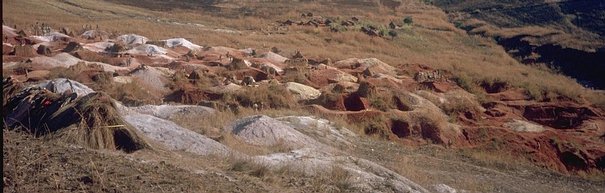
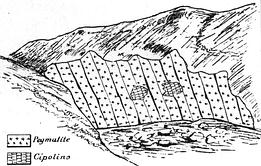
| Sketch of the Antsongombato mine ( Antsirabe area) |
|
| at the beginning of the 20th century. The attack |
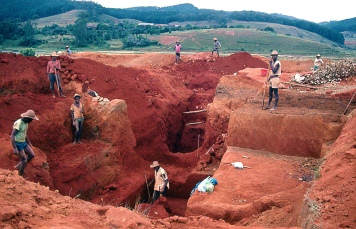
Mine of Alakamisy Itenina ( Fianarantsoa area, |
| measured about fifteen meters, the coal face was to |
Madagascar). |
| hillside 10 meters above the brook, it showed the |
This mine is worked in alluvium, the first stones were |
| presence of a large sill of hard pegmatite, laid out in |
discovered in 1989 in a rice plantation. It produced |
| benches lities by a secondary cleavage. To the wall |
rubellites and remarkable tourmalines with geometrical |
| one sees a schistous limestone, greenish and broken up, |
drawings. © Image J. Darbellay |
| to the roof, one distinguishes only clay. This |
|
|
| occurrence was famous for its red-ruby tourmalines. |
|
| |
|
|
| |
 |
|
Your guide to GGGems |
 |
©  All of the pictures on this website have been shot by gggems.com All of the pictures on this website have been shot by gggems.com |
Alain Darbellay |
| Text written by Alain Darbellay. |
|
|